
Itasca County Multi-Day Arrest Reports
Itasca County publishes no multi-day arrest blotter and no downloadable sheriff archive. So start with the official sheriff roster. It answers the custody question directly. Booked dates appear on live entries. Released people, though, carry no promise of staying online, and the county names no archive depth. The most useful comparison is RecentlyBooked's Itasca County page. It labels its window "last 30 days," groups records by date, and refreshes several times daily. That helps when hunting a likely booking date. Treat it as a private index rather than proof of coverage, and confirm anything with the sheriff, the record custodian, or the court.
Read Itasca Arrest Reports Carefully
Work backward from a likely date, then move to the agency that owns the record. Grand Rapids and Coleraine arrests may reach the county roster. Entry requires lodging at Itasca County Jail. Cohasset gets police service from the sheriff itself. Still, citations, releases without county lodging, juvenile matters, protected records, and custody held elsewhere can all stay off the roster.
- Search the official roster for current Itasca County custody.
- Compare name, inmate ID, age, booked date, and charge context.
- Use the rolling 30-day page only to identify a possible date or agency.
- Ask the sheriff or city police custodian for the existing report.
- Check Minnesota Court Records Online for a filed case and disposition.
The Arrested Today page covers fresh intake and posting lag. This multi-day route suits a different moment. Use it after a weekend passes, after a release, or when the live row disappears. City and county records answer different questions too. Grand Rapids and Coleraine police keep their own files. Those files exist even when someone lands in the county jail. A multi-day county hit gives a booking lead. It rarely holds the officer narrative, the citation, or the city incident number. Ask the agency that created that material. No jail intake may have happened at all. Then a city or sheriff incident record may be the only arrest record that exists.
Itasca Arrest-Report Fields Compared
The official and unofficial views show different fields. Never credit a secondary field to the sheriff just because it sits beside an Itasca booking online.
| Field | How to treat it |
|---|---|
| Name and inmate ID | Observed on the official roster; use the ID to reduce same-name errors. |
| Booked date | Jail intake date, which may differ from arrest date. |
| Reported charges | Accusations recorded at booking, not convictions. |
| Age and gender | Roster details; neither proves identity alone. |
| Booking ID and agency | May appear in the private index; verify with the custodian. |
| Physical descriptors | Private-index fields, not confirmed as consistent sheriff fields. |
| Booking photo | Seen on current adult entries; availability is not permanent. |
A disposition is the case result that comes later. Search Minnesota Court Records Online once a public case is filed; MCRO is not a custody feed, and access limits apply.
Itasca’s Unofficial 30-Day Layer
The county-specific rolling source visibly identifies its last-30-days scope.
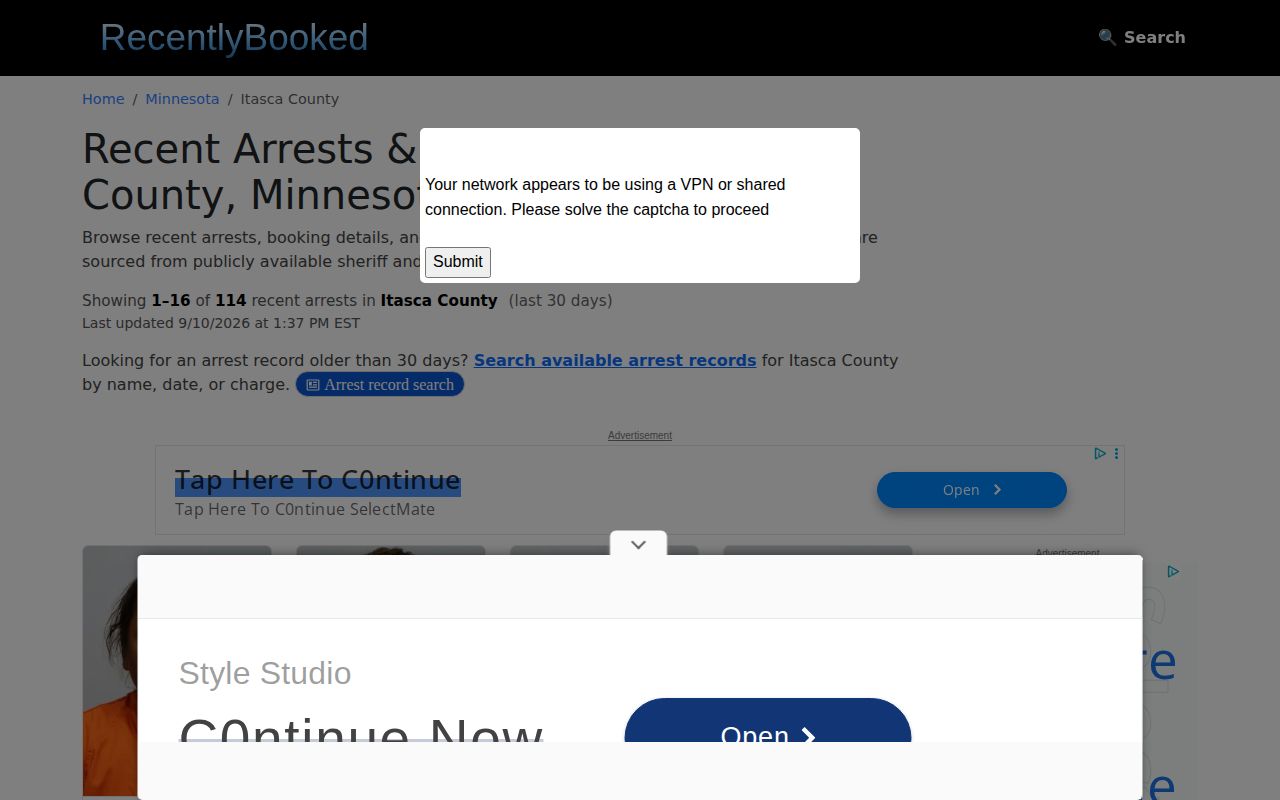
The site claims a thirty-day window, nothing more. It is not an official archive. Nor does it prove every arrest is included. A missing entry can mean a missed update, a correction, protected data, another jail, or publisher coverage rules. A listed entry can outlive a case. It never shows current custody. Turn to the sheriff roster or VINE for status, and to the court for disposition. The private record pages show richer fields: a booking ID, an arresting agency, physical descriptors, and a photo. All of it stays secondary publication until matched to an official inmate ID, an agency report, or a court case. Date groupings narrow a request, but they cannot reconcile conflicting spellings, charge labels, or release status.
Weekend Itasca Arrest Report Limits
Nothing establishes an Itasca weekend surge, holiday backlog, or fixed publishing calendar. No pattern holds. Claiming weekend arrests surface on Monday, or that the private page skips certain days, would be guesswork. Timing depends on transport, intake, release, transfer, system updates, and source collection. So a Monday search should span several dates. Booking time is not always arrest time. Check the roster, note the likely event date from a secondary lead, and request the actual booking or incident record. If custody is urgent, call the sheriff. Holidays deserve the same restraint. The county issues no statement that entries pause, batch, or post the next workday. The roster shifts with custody. A private collector publishes on its own schedule. Preserve each source's displayed date and label rather than assuming arrest, booking, web posting, and news coverage all happened at once.
Note: A grouped date is a navigation aid, not a county-certified statement about timing or completeness.
Request Older Itasca Arrest Records
Older booking material in Itasca County sits with the Sheriff's Records Division. That includes arrest reports, jail-register entries, and booking photos. Sheriff booking sheets that have dropped off any live roster count too. Phone the office at 218-327-7472 on weekdays between 8:00 a.m. and 4:30 p.m. The county request form names records@co.itasca.mn.us and fax 218-326-4663. The mailing address is 440 1st Ave NE, Grand Rapids, MN 55744. One catch: the current sheriff page shows 108 NE 5th Street. Confirm where to send it before anything goes in the mail.
Be specific about the arrest record you want. Name the person and the date range. Include the booking or incident number if you have it. Also give the agency that made the arrest and the type of record. Ask directly if something is missing. A record may still sit with the county. It may have been transferred instead. Or it may have been destroyed under an approved schedule. The form mentions fees and prompt handling but quotes no flat photo price or fixed deadline. Nail down the cost first.
The county form treats inspection and copies as separate options. Request the smallest set that answers your question. A jail-register entry, the booked-charge field, a release date and type, or a single booking photograph may be enough. Some parts may be private, confidential, or protected. Minnesota law allows that label even when other arrest data is public. If staff withhold or redact something, ask them to name the classification and its legal basis. Don't assume the whole booking event is off limits.
108 NE 5th Street
Grand Rapids, MN 55744
218-327-7472
Monday–Friday, 8:00 a.m.–4:30 p.m.
Itasca Arrest Archives Beyond Thirty Days
The live roster publishes no retention period, and a private 30-day page is not an archive. So where do older Itasca arrest records go? The Minnesota State Archives government-records page explains that counties work from either general schedules or locally adopted ones. The general county schedule names adult jail registers, intake records, daily logs, inmate history records, dispatch logs, criminal records, warrants, and photographs. Even so, those categories set no single retention term for every Itasca record.
A Minnesota Historical Society finding-aid index lists an Itasca County Sheriff Jail Register accession. Treat it as a historical lead, not a searchable current arrest log. Start with county Records. If material moved, cite the collection title and contact State Archives. The official archives page carries the county-records guidance and schedule links.
Archives guidance helps you find the custodian. It cannot promise a booking photo still exists.
News Is Not an Itasca Blotter
Local newsrooms cover crime, but none runs a blotter. The Grand Rapids Herald-Review, KAXE local news, and Duluth News Tribune local news each pick stories worth telling rather than listing every arrest. No Itasca County arrest report, daily blotter, or custody list comes from them. The KAXE section shows regional reporting, not roster coverage.
A news story adds context and names its sources. Still, verify any arrest claim against agency and court records. Juvenile, sealed, and active-investigation data carry their own limits. Treat the story as a starting point, never the record itself.
Preserve the Itasca Source Date
Any multi-day result needs its source and capture date attached. The live roster shifts after a release or transfer. A private archive may hold an older copy. Save the exact record URL and note the date you viewed it. Then request the county record for that period. Don't blur a roster timestamp, a posting date, and an incident time into one field. They are not the same.
When a correction matters, start with the agency that created the record. A publisher's free correction path fixes its own copy and nothing else. The sheriff file and the court outcome stay as they are. Sealed, expunged, juvenile, misidentified, and protected records each follow their own official process. The Itasca County recent arrests hub ties the roster together. It also covers booking-photo law and the records route.
Public Record Search
Sponsored Results